eBlackChampaign-Urbana Announcement for American History Teachers Collaborative
The eBlackChampaign-Urbana (eBlackCU) project is a University of Illinois-led project that seeks to 1) Centralize information on local African-American history and culture and create new knowledge through this centralization; 2) Involve past and present community residents in the production of knowledge by soliciting their contributions, both in the form of personal memories and in the form of digitized personal archives; 3) Create a community of scholars, activists, educators, students and citizens interested in learning more about various aspects of local African-American history and culture and using that knowledge in the present; and 4) Develop the best-practices to scale this project up to the state-level in the implementation of
eBlackIllinois: A Comprehensive Database on the Black Experience in Illinois.
The project's web address is http://www.eBlackCU.net.
The project started in November 2009 and will continue at least through the end of December 2010, with our hopes being to find a way to continue the project, or aspects of the project.
Our products have thus far included:
a) A bibliography of information sources on local African-American issues, http://eblackcu.net/portal/items/show/2
b) A digital library of newly digitized information sources and websites on local African-American issues, http://eblackcu.net/portal/
c) Two digital exhibits that bring together these information sources in a narrative frame-work on Salem Baptist Church and the North First Street Business Community, http://eblackcu.net/portal/exhibits
We intend to add more items to the bibliography, more digitized texts to the digital library and more digital exhibits throughout the year.
Our goal in all of this is to make the project as collaborative as possible. ANYONE can submit information of ANY type to the website using our contribute form: http://eblackcu.net/portal/contribution.
All submissions are vetted by the project team before appearing online and e-mails are required in case follow-up contact with submitters are required.
In addition to the website we will have three other main outputs from this project: 1) A print/digital publication of University of Illinois research relating to local African-American issues written at a level accessible to a high school audience which will be distributed to area high school and public libraries, as well as to community groups, and will also be available online; 2) A campus-community symposium slated for November 5-6 (location TBA) that will focus on the documentation of African-American history in Champaign-Urbana, research on local African-American issues, digital technology and African-American culture, and broadband and the future of the African-American Community in Champaign-Urbana. All are welcome to attend and more information will be distributed as it is announced; and 3) We are hiring six high school and Parkland age African-American interns to learn how the eBlackCU website works, become proficient in digital libraries/digital exhibits, and serve as spiders to get the project spread throughout the community. Our second goal in hiring interns is to help them and their peers get into the University of Illinois.
All are welcome to contribute to and become a part of this project.
For volunteer opportunities and to stay up-to-date with news on the project as it happens visit our blog http://eblackcu.net/blog/ and Facebook page: http://tinyurl.com/2clbrta.
The project director for eBlackCU is Noah Lenstra (nlenstr2@illinois.edu), a Certificate of Advanced Study student in the Graduate School of Library and Information Science
(http://www.lis.illinois.edu/) at UIUC and the supervising investigator is Abdul Alkalimat (mcworter@illinois.edu), Professor of African-American Studies (http://www.afro.illinois.edu/) and Library and Information Science. This project is funded by the Office of the Vice Chancellor for Public Engagement (http://engagement.illinois.edu/) and the Community Informatics Initiative (http://cii.illinois.edu/). Public partners include the Champaign County Historical Archives (http://www.urbanafreelibrary.org/archives/), Urbana Free Library; and the Early American Museum (http://www.earlyamericanmuseum.org/): The Heritage Center of Champaign County, Champaign County Forest Preserve.
Monday, May 24, 2010

Tuesday, May 18, 2010
Civil War Mini-Summer Institute
On May 14th and 15th, fifty teachers joined us in the Urbana Middle School and Fishers, Indiana for a day and a half workshop about the Civil War. Professor Bruce Levine, J.G. Randall professor of History at the University of Illinois, joined us on Friday night for a lecture on Abraham Lincoln and his role in the Civil War. Professor Levine argued that the Civil War was an unprecedentedly transformative event in American history and guided us through an exploration on Lincoln's writings and behaviors of that period. Holding up the binary of "actor" or "acted upon," Professor Levine found that Lincoln fell somewhere in the middle, arguing that while Lincoln frequently reacted to events rather than reaching out to shape them, his reactions were guided by consistent, firmly held beliefs and principles.
 After Professor Levine's keynote, the group had an hour of question and answer which led to some really great discussions about Lincoln and the Civil War generally.
 Saturday morning, we reconvened for the bus trip to Conner Prairie. Conner Prairie is a living history museum in Fishers, Indiana, that preserves the William Conner home, and recreates part of life in Indiana in the 19th century. On Saturday, May 15th, they were celebrating "Civil War Days," an exploration of life during the Civil War, complete with a reenacted skirmish between Union and Confederate troops.
 A few of our Robeson teachers enjoyed watching a Civil War surgeon explain his craft,
 and then the armies began to move.


 After Professor Levine's keynote, the group had an hour of question and answer which led to some really great discussions about Lincoln and the Civil War generally.
 Saturday morning, we reconvened for the bus trip to Conner Prairie. Conner Prairie is a living history museum in Fishers, Indiana, that preserves the William Conner home, and recreates part of life in Indiana in the 19th century. On Saturday, May 15th, they were celebrating "Civil War Days," an exploration of life during the Civil War, complete with a reenacted skirmish between Union and Confederate troops.
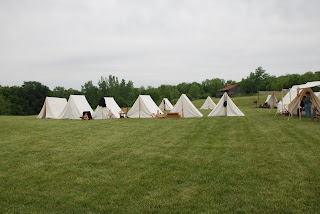
This is the army encampment. It was just about lunchtime when we arrived.
 A few of our Robeson teachers enjoyed watching a Civil War surgeon explain his craft,
 and then the armies began to move.

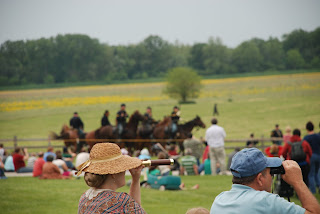
The soldiers, men and boys, marched grimly to the battlefield.


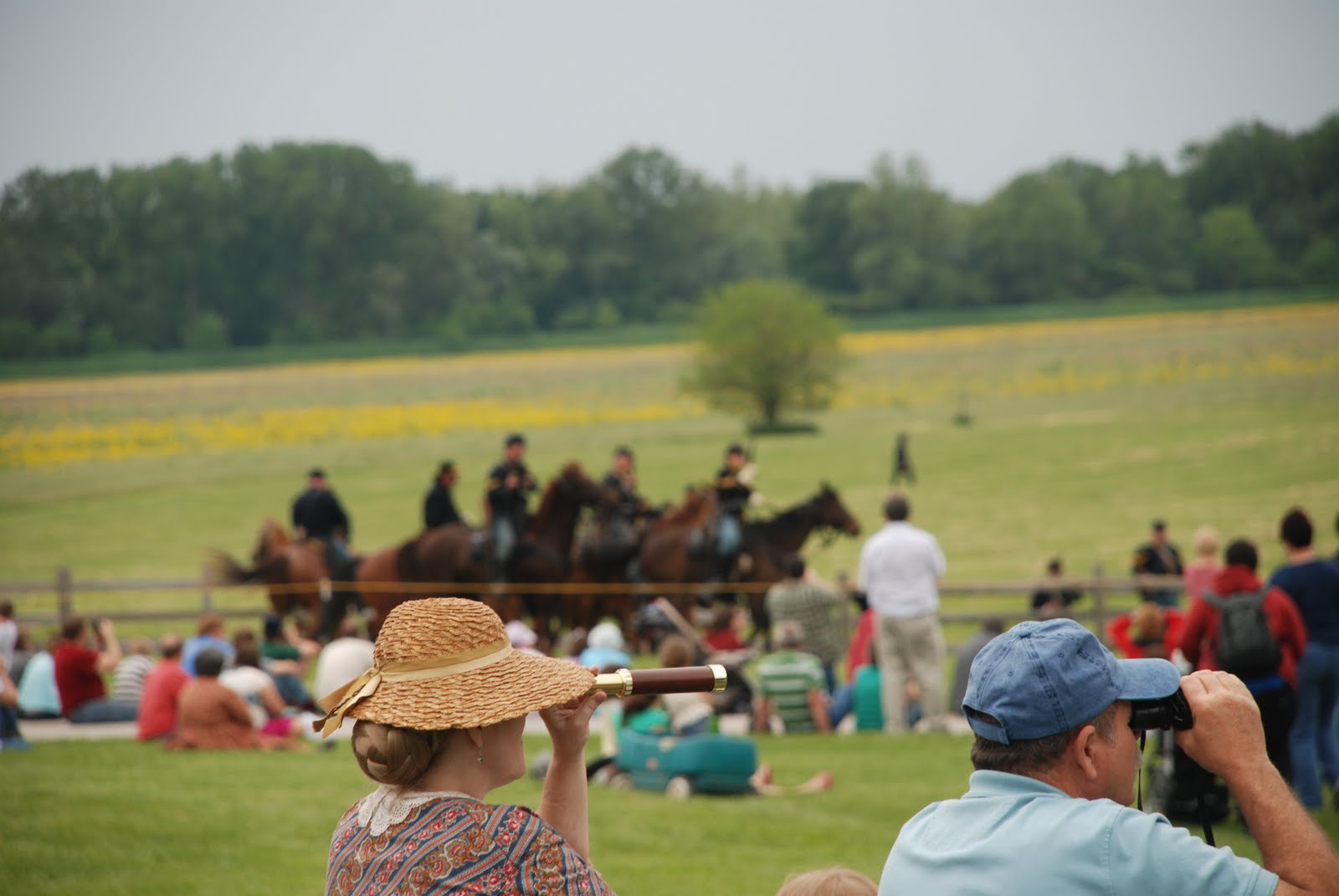
Smoke billowed from artillery fire, as spectators, modern and otherwise, looked on.

Conner Prairie put together a great program of events, including lectures from the Union 28th Colored Unit, a tomahawk throwing competition in the Lenape village and reenactments of Civil War dress, cooking, medicine and photography. Overall, it was a very fun day and a new way to learn about life in 19th century America.

Friday, May 7, 2010
Resources Available from Some of Our Partners
Anyone who has done a Summer Fellowship is aware that our partner museums and archives have an amazing collection of primary sources available to work with, but outside the context of a fellowship, it is easy to forget to utilize them. Two of our partners are making it easier for you to access these sources to use in your classrooms.
The Champaign County Historical Archives has a new digital collection of photographs from the archives. Historic Champaign County: Neighborhoods and Homes includes photographs of homes, public buildings and neighborhoods that represent the architectural history of the area. You can access this collection at urbanafreelibrary.org/archives/collections/.
The Illinois State Archives has pulled together six teaching packets to encourage the use of primary sources in the classroom. These packets, which contain a teacher's manual and a set of document reproductions, are free for Illinois teachers and educational institutions. The packets available are:
The Champaign County Historical Archives has a new digital collection of photographs from the archives. Historic Champaign County: Neighborhoods and Homes includes photographs of homes, public buildings and neighborhoods that represent the architectural history of the area. You can access this collection at urbanafreelibrary.org/archives/collections/.
The Illinois State Archives has pulled together six teaching packets to encourage the use of primary sources in the classroom. These packets, which contain a teacher's manual and a set of document reproductions, are free for Illinois teachers and educational institutions. The packets available are:
- "Abraham Lincoln in Illinois"
- "Hard Times in Illinois, 1930-1940"
- "The Illinois and Michigan Canal, 1827-1911"
- "Illinois at War, 1941-1945"
- "Early Chicago 1833-1871"
- "From the Ashes, 1872-1900" (Chicago's development after the Great Fire to the turn of the century.)
Thursday, April 29, 2010
Money, Materialism, Monopolies and Millionaires
April has been a busy month, bringing our two part workshop series on economics and industrialization. Seventy teachers joined us in Urbana Middle School on April 17th and 24th for an in-depth look at how economics could be brought into the classroom. We opened the series with a keynote from Dr. Mark Leff, who used charts and graphs to root his discussion of finance between the Gilded Ages in concrete examples.

After small group discussions with Dr. Leff, time in the computer lab and boxed lunches from Za's, everyone reconvened to discuss how they could use the fabulous books, magazines, videos and website lists that they had been given that morning.

Next Project Director Kathy Barbour and Program Coordinator Alexis Jones led us in some great economics lessons. In Kathy's room, teachers studied how the Constitution has shaped the economic system of the United States.
 Everyone was working hard...even Activity Coordinator Jen Bredemeier and AHTC Bookkeeper Ambar Rizwan joined in the historical fun!
 Meanwhile, Alexis used the children's book Saturday Sancocho to teach us all about bartering. We all had a wonderful time trying to gather chickens, carrots and cumin to make our own sancocho.

After a fun day of economics activities, everyone returned home, where I'm sure they were anxiously awaiting next Saturday, April 24th.
We kicked off our second day with a keynote by Lead Historian Dr. Jim Barrett. Dr. Barrett discussed the way industrialization transformed both the people who experienced it and the way we think about and perform work. As part of his keynote, Dr. Barrett led us in a document analysis exercise using An Exposition of the System of Moral and Mental Labor, established at the Glass Factory of Dyottville in the County of Philadelphia by T.W Dyott (1833) and The Factory Bell from The Factory Girls' Garland (1844).

Next, Urbana High School teacher Matt Buckles led the group in a lesson on the uses of space and land throughout the pre-industrial, industrial and post-industrial periods. Everyone enjoyed the map analysis and playing with the magnifying glasses!


In the computer lab, Alexis led the group through some of the best websites on the economy and the census that we had found in our preparation for these days. As always, website lists can be found on our website under Web resources. One of the favorites was a video from 1904 of women punching in at a Westinghouse company.
 To round out our day, William Maury, the Lead Historian of the U.S. Census Bureau came to discuss with us how the census became what it is today.

Thank you all for giving up two spring Saturdays to join us for these workshops, and thanks to all of our presenters for making both days so interesting and informative!

After small group discussions with Dr. Leff, time in the computer lab and boxed lunches from Za's, everyone reconvened to discuss how they could use the fabulous books, magazines, videos and website lists that they had been given that morning.

Next Project Director Kathy Barbour and Program Coordinator Alexis Jones led us in some great economics lessons. In Kathy's room, teachers studied how the Constitution has shaped the economic system of the United States.
 Everyone was working hard...even Activity Coordinator Jen Bredemeier and AHTC Bookkeeper Ambar Rizwan joined in the historical fun!
 Meanwhile, Alexis used the children's book Saturday Sancocho to teach us all about bartering. We all had a wonderful time trying to gather chickens, carrots and cumin to make our own sancocho.
After a fun day of economics activities, everyone returned home, where I'm sure they were anxiously awaiting next Saturday, April 24th.
We kicked off our second day with a keynote by Lead Historian Dr. Jim Barrett. Dr. Barrett discussed the way industrialization transformed both the people who experienced it and the way we think about and perform work. As part of his keynote, Dr. Barrett led us in a document analysis exercise using An Exposition of the System of Moral and Mental Labor, established at the Glass Factory of Dyottville in the County of Philadelphia by T.W Dyott (1833) and The Factory Bell from The Factory Girls' Garland (1844).

Next, Urbana High School teacher Matt Buckles led the group in a lesson on the uses of space and land throughout the pre-industrial, industrial and post-industrial periods. Everyone enjoyed the map analysis and playing with the magnifying glasses!


In the computer lab, Alexis led the group through some of the best websites on the economy and the census that we had found in our preparation for these days. As always, website lists can be found on our website under Web resources. One of the favorites was a video from 1904 of women punching in at a Westinghouse company.
 To round out our day, William Maury, the Lead Historian of the U.S. Census Bureau came to discuss with us how the census became what it is today.
Thank you all for giving up two spring Saturdays to join us for these workshops, and thanks to all of our presenters for making both days so interesting and informative!
Wednesday, April 21, 2010
A Great Resource To Explore!
The National History Education Clearinghouse website is an amazing website to pour through if you haven't already. With lesson plan reviews, teaching guides, and examples of best practices, it is full of great ideas and resources. Make sure to check out the history in multimedia exhibit, as well as the interviews with historians and master teachers. Easily searchable by elementary, middle or high school levels, this site is worth spending some time on. Make sure, in your exploration, that you check out the page featuring AHTC teacher Christine Adrian's Lincoln lesson plan Chic, Virginia, and Mr. Lincoln: Understanding Historical Perspective.
Tuesday, April 13, 2010
Common Core State Standards Initiative
I'm sure all of you have heard of the Common Core State Standards Initiative (if you haven't, please read the great article here and peruse the website here.) These college-and career-readiness standards were first released for public comment in September of 2009, and a draft of the K-12 standards were released for comment in March of 2010. The newest version of these standards, including those in Social Studies, have just been released. You can find the PDF of the new Social Studies standards here. [Edit: While we are excited about this newest draft, we did not intend to imply that the work on these standards is finished. So far, these Social Studies standards deal only with literacy. Someday we hope that Social Studies specific standards will be developed, but in the meantime, please do read about these literacy standards. Thank you to our commenter for pointing out that we were not clear on this point.]
The CCSSI has the greatest general support of education reforms currently being developed, and offers one of the most promising opportunities to improve education through better standards and assessments. Ending the differing expectations between the states can only improve the quality of education throughout the nation. These Social Studies standards have been developed through cooperation by organizations in civics, economics, geography and history (You can find a list of participating organizations at the end of the first linked article.) This single set of standards will drive assessment systems, as well as curriculum and instructional practices. We have been following this initiative with interest, and we encourage you to check out the new standards.
The CCSSI has the greatest general support of education reforms currently being developed, and offers one of the most promising opportunities to improve education through better standards and assessments. Ending the differing expectations between the states can only improve the quality of education throughout the nation. These Social Studies standards have been developed through cooperation by organizations in civics, economics, geography and history (You can find a list of participating organizations at the end of the first linked article.) This single set of standards will drive assessment systems, as well as curriculum and instructional practices. We have been following this initiative with interest, and we encourage you to check out the new standards.
Friday, March 12, 2010
The AHTC Google Calendar!
In yet another technological step forward, the AHTC now has a Google Calendar!
We know many of you already have a Google Account to use Gmail, Google Docs, and hopefully Google Calendar. Subscribing to the AHTC Google Calendar is a snap, just follow these instructions.
1. Open your Google Calendar.
2. In the Other Calendars box, click Add.
3. Click Add by URL.
4. Paste the following URL: http://www.google.com/calendar/ical/6naidujhnndos9o45pjrt675ks%40group.calendar.google.com/public/basic.ics
That's it! You now have access to the American History Teachers' Collaborative Google Calendar! We will update it regularly with event dates and registration deadlines.
No information will be posted on the calendar that has not already been distributed via email, but this is a great way to keep up with the myriad of great events we host.
If you don't already have a Google Account, consider signing up for one. They're free! Signing up for a Google Account gives you access to Gmail, Google Calendar, Google Docs, and a assortment of other great tools!
We know many of you already have a Google Account to use Gmail, Google Docs, and hopefully Google Calendar. Subscribing to the AHTC Google Calendar is a snap, just follow these instructions.
1. Open your Google Calendar.
2. In the Other Calendars box, click Add.
3. Click Add by URL.
4. Paste the following URL: http://www.google.com/calendar/ical/6naidujhnndos9o45pjrt675ks%40group.calendar.google.com/public/basic.ics
That's it! You now have access to the American History Teachers' Collaborative Google Calendar! We will update it regularly with event dates and registration deadlines.
No information will be posted on the calendar that has not already been distributed via email, but this is a great way to keep up with the myriad of great events we host.
If you don't already have a Google Account, consider signing up for one. They're free! Signing up for a Google Account gives you access to Gmail, Google Calendar, Google Docs, and a assortment of other great tools!
Subscribe to:
Posts (Atom)


